
Checking Criminal History in Florida
Start with the record that answers the question. FDLE CCHInet supplies a paid, name-based Florida criminal history drawn from reported fingerprint-supported arrest cycles. It is useful for a statewide chronology. It is not the full file. County clerks hold felony and misdemeanor case dockets, county jails show recent local custody, and the arresting agency keeps the incident report. ACIS covers appeals only. FDC tracks state prison and adult felony supervision. Each source has a distinct job.
A sound Florida record check uses more than a name. Gather a full name, date of birth, likely county, and rough date. Search the statewide source, then verify each event where it began. A name result is not positive identification. For your own record, fingerprints offer the firm match and a path to correct missing or wrong data.
- Choose the record type and likely Florida county.
- Use CCHInet for a statewide Florida chronology.
- Check the county clerk, jail, or creating police agency.
- Compare charges with the docket disposition and sentence.
- Use FDLE Personal Review for your own fingerprint-verified file.
The FDLE Florida checks page shows the official product choices.
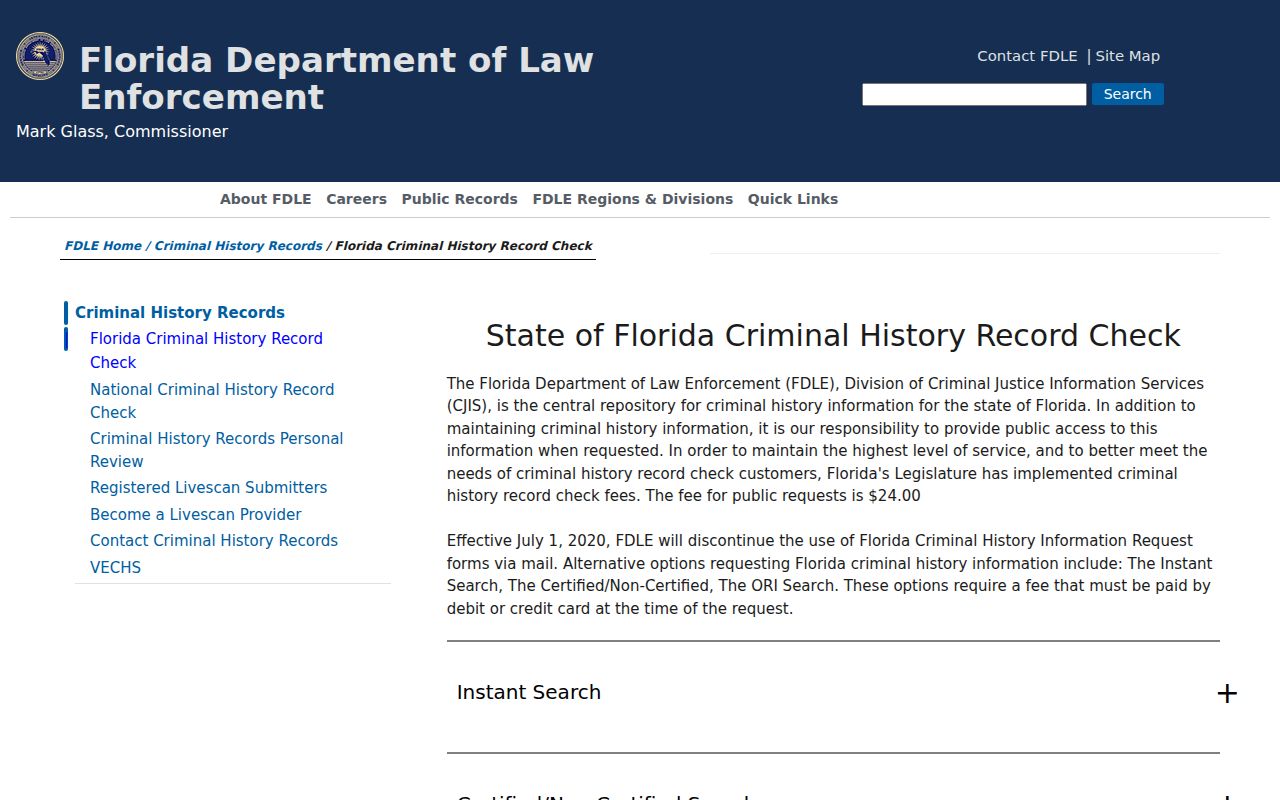
Those choices separate quick demographic searching from certified mail results and fingerprint-based personal review.
CCHInet Florida Search Fields
CCHInet leads a public user through payment information, search criteria, confirmation, payment, candidates, and results. Terms must be accepted first. The search asks for last name, first name, race, sex, and date of birth. Middle name and Social Security number are optional. Aliases can be added. Accurate birth data helps narrow candidate matches, while a full Social Security number displays only as the last four digits during selection.
The candidate session has a 30-minute limit after card details are entered. Choosing another candidate creates another charge. “None of the Above” is a final search response, not a refund trigger. A timeout can send the transaction to manual demographic review. Print or email the result before leaving the session.
| Field | Required | Florida Search Note |
|---|---|---|
| First and last name | Yes | Combined name and suffix length is limited |
| Race and sex | Yes | Used to build the candidate list |
| Date of birth | Yes | A key demographic match field |
| Middle name and aliases | No | Can narrow or broaden known-name matching |
| Social Security number | No | Must be complete if supplied |
The official CCHInet interface shown below begins the Florida search.
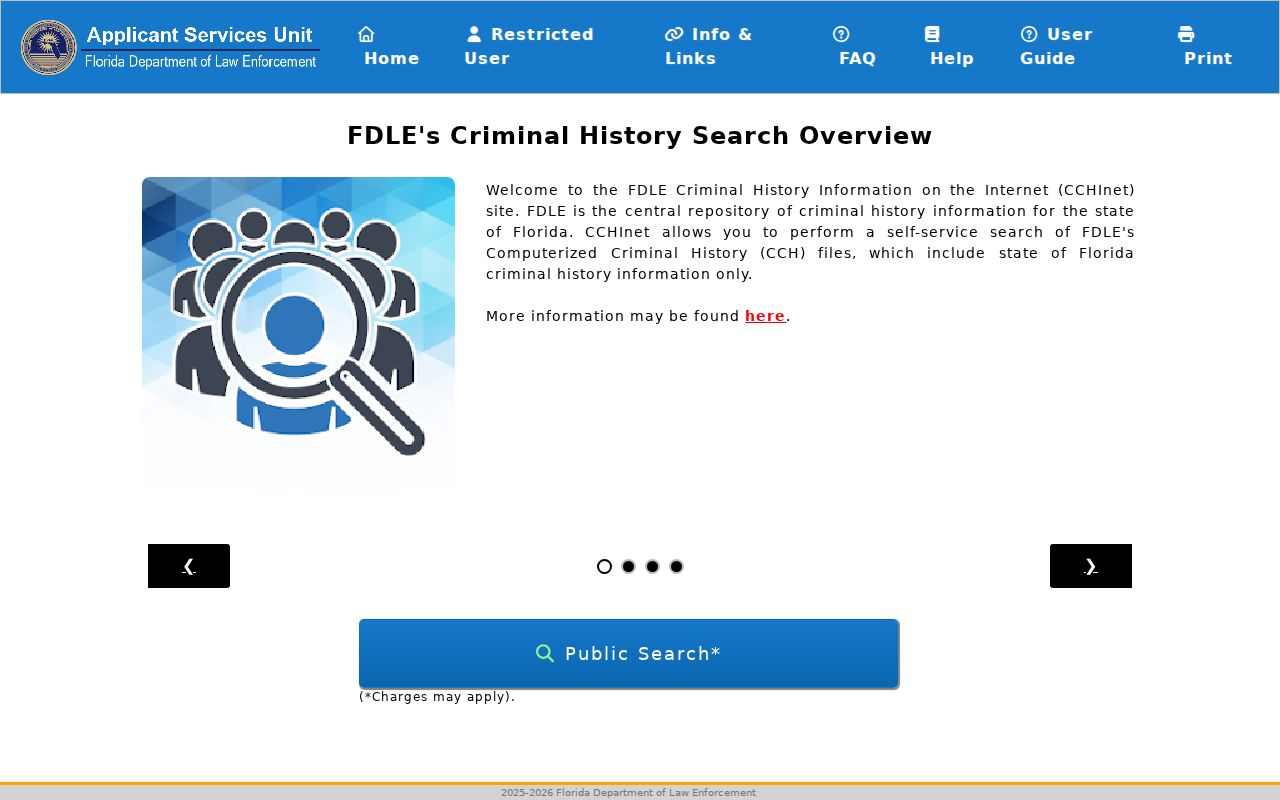
The form makes clear that a demographic candidate is not a fingerprint-positive identity match.
Note: CCHInet covers Florida submissions, not federal records or criminal history created only in another state.
Inside the Florida Criminal History Repository
The Florida Department of Law Enforcement, Division of Criminal Justice Information Services, is the central repository. Its Computerized Criminal History file links identity data to fingerprint-supported arrest cycles. A cycle may include the arresting agency, charges, disposition, sentence, and later incarceration data when agencies report each part. The Florida Crime Information Center serves authorized justice users, while CCHInet is the public name-search product.
FDLE can connect events from several Florida counties. One clerk cannot do that. Yet FDLE does not replace any clerk. A notice to appear, direct-file prosecution, or sworn complaint may create a real court case without entering CCH when no prints were taken. Missing or late dispositions cause more gaps. For a focused account of products, fees, LiveScan, and correction rights, use the FDLE criminal records agency profile.
- SID
- The durable Florida state identity number linked to fingerprints.
- TCN
- The transaction control number for a specific fingerprint submission.
- OBTS number
- The identifier used to connect an arrest transaction with later reporting.
- Rap sheet
- A chronological compiled criminal history, not a copy of every court document.
Florida Arrests Reach FDLE Records
A Florida arrest begins with the sheriff, city police, Florida Highway Patrol, FDLE, campus police, or another authorized agency. If the person is booked for a qualifying event, the booking agency captures demographics, fingerprints, palm prints, and a facial image. The electronic transaction reaches FDLE and is checked against the state biometric file. Fingerprints, not a similar name, establish repository identity.
The State Attorney then files charges or declines them. The county clerk opens the court docket and stores pleadings, orders, judgments, and sentences. Florida law calls for uniform dispositions to reach FDLE at least monthly. OBTS data connects that result to the arrest cycle. FDC adds biometric data when it receives a person sentenced to a state institution.
Florida record flow: Arrest and booking → fingerprint transaction → county prosecution → clerk disposition → FDLE criminal history.
If the docket and CCH disagree, first get the clerk's certified disposition. Then request FDLE Personal Review for your own file and use the challenge process with source documents. The originating agency decides what its own event should say. FDLE updates the state history after validation.
Note: A county disposition can exist before FDLE receives or correctly links it to the matching Florida arrest cycle.
Florida Warrant Search Limits
Florida's Public Access System offers a free wanted-person search based on selected information reported to FDLE. It refreshes from Florida Crime Information Center files every 24 hours. That makes it a useful first check, but not a live certification. A missing result does not prove there is no warrant. An old result does not prove a warrant remains active.
Search by a last-name fragment or exact nickname, then add first and middle name, race, sex, date of birth or age. PAS can show the reporting agency, warrant or case number, offense, date, descriptors, image, and agency phone when supplied. Results are capped. Descriptors may be estimated, old, or tied to false identity data.
The FDLE Public Access System provides the statewide starting point.
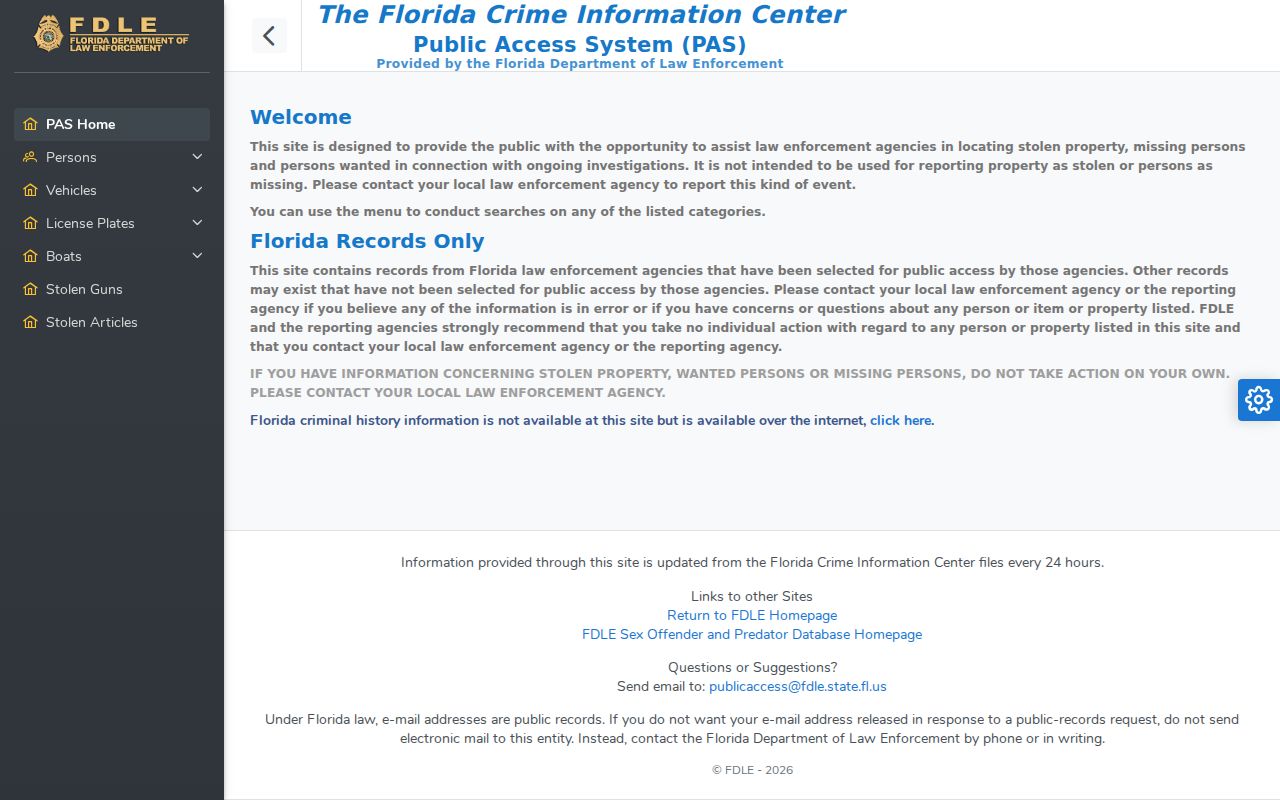
Confirm any Florida warrant with the reporting agency and issuing county court before acting on the display.
A capias is a court command to take a person into custody. A bench warrant often follows a missed court duty. A search warrant authorizes a search and is not a wanted-person listing. The county docket can show issued, served, returned, or recalled events. The local sheriff confirms service status. Never approach a listed person.
Florida Statewide Record Systems
Florida has statewide databases, but no one database covers all criminal records. FDLE CCHInet compiles reported Florida arrest cycles and outcomes. FDC Offender Search covers state prison and state felony supervision. The Florida Sexual Offender and Predator Registry compiles registration data from sheriffs, FDC, courts, and other agencies. ACIS searches the Supreme Court and six district courts of appeal. It does not search trial dockets held by 67 clerks.
| Florida System | What It Holds | Run By |
|---|---|---|
| CCHInet | Public Florida criminal history | FDLE |
| Corrections Offender Network | State prison and felony supervision | Florida Department of Corrections |
| Sexual Offender and Predator Registry | Statewide reported registration profiles | FDLE Offender Registry Services |
| ACIS | Supreme Court and appellate cases | Florida Courts |
| PAS | Selected public wanted-person entries | FDLE |
Note: Current county custody, Florida state custody, and federal custody always require three distinct official search systems.
The FDLE registry search provides name, county, city, ZIP, and neighborhood routes.
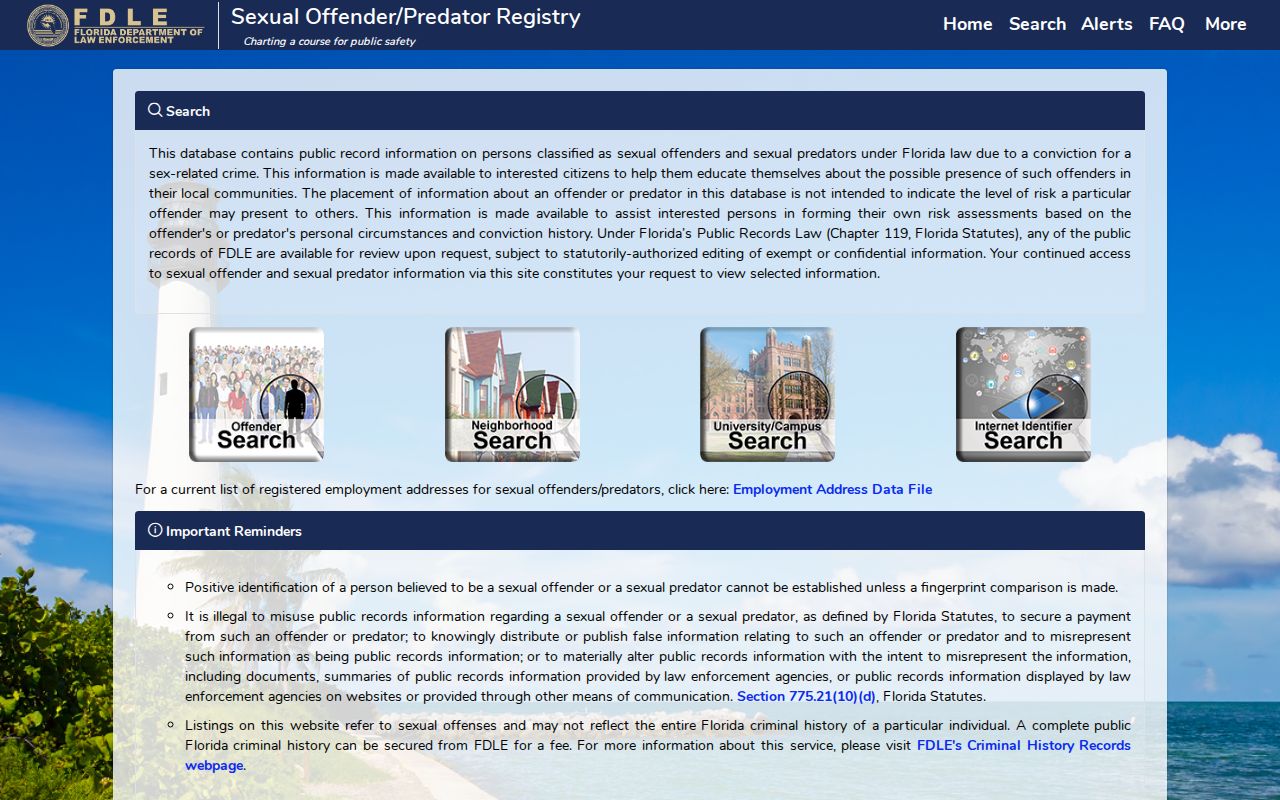
Registry designations are legal categories, not a risk score. The Florida sex offender search details profiles, alerts, and lawful use.
Florida Custody Record Layers
Custody searches split into local, state, and federal layers. A Florida county jail holds many people before trial, on local sentences, during warrant holds, or while awaiting transfer. Florida has no complete public statewide county-jail roster. Start in the county of arrest. A person can appear there before the clerk opens a case, then disappear from a current roster after release.
FDC holds people sentenced to Florida state prison and supervises adult felony probation, community control, and post-prison release. Its free Corrections Offender Network can search by name or DC number. The system excludes people whose custody or probation remains solely at county level. In June 2024, FDC reported 87,303 state prisoners and 145,948 total community-supervision cases.
Federal custody is separate. A local roster may briefly show a federal detainee, but the federal docket belongs in PACER and a sentenced federal prisoner belongs in the Bureau of Prisons locator. Do not assume the nearest prison to the sentencing court is the current facility. Transfers happen.
- County custody
- Use the official jail roster for local current custody and recent bookings.
- Florida state custody
- Use FDC Offender Search for state prison and adult felony supervision.
- Federal custody
- Use the BOP Inmate Locator after commitment to the federal prison system.
Types of Florida Criminal Records
Florida records differ by creator and purpose. The arresting agency writes the incident or probable-cause report. A county jail creates the booking record. The State Attorney files an information, while a grand jury may return an indictment. The clerk builds the trial case file. FDLE compiles reported fingerprint-linked history. A judge issues a warrant or capias, and the local agency maintains service data.
- Arrest report: alleged event and investigation, subject to Florida exemptions.
- Booking record: local intake, initial charges, bond, holds, and custody status.
- Court file: filed charges, docket events, orders, outcome, and sentence.
- FDLE history: reported Florida arrest cycles connected across counties.
- Custody record: jail, state prison, or federal status in separate systems.
- Registry record: current reported regulatory data, not a full rap sheet.
One event can create several accurate records with different facts. The jail reflects the initial charge. The prosecutor may file a different charge. The judgment controls the final court result. FDLE depends on later reporting to attach that outcome. Comparing the identifiers and dates prevents false conclusions.
Florida Probation and Parole Records
Florida uses a hybrid supervision structure. FDC Community Corrections supervises adult felony probation, community control, pretrial intervention, and post-prison release across a statewide network. A county court may assign misdemeanor probation to a county agency, FDC when law allows, or a court-approved private provider. The sentencing docket is the sure source for who supervises a specific misdemeanor case.
Traditional parole applies mainly to older eligible sentences because Florida ended parole for most offenses committed on or after October 1, 1983. The Florida Commission on Offender Review handles parole and other discretionary release work. FDC officers carry out community supervision. FCOR also handles conditional release, conditional medical release, revocations, and clemency functions.
The Florida Commission on Offender Review publishes release information and hearing resources.
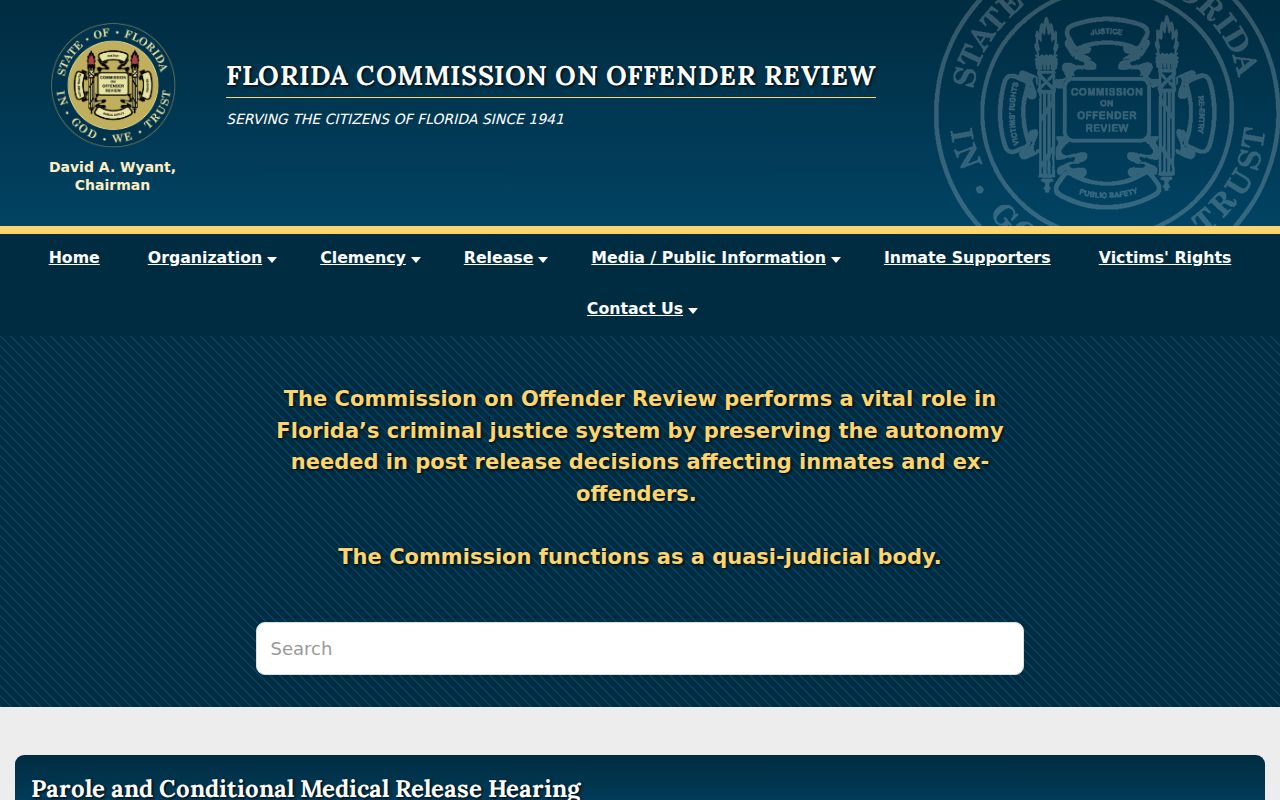
Use the county criminal docket for the sentence and violation events, FDC for current state supervision, and FCOR for its release decisions.
Some supervision material is confidential. Florida law protects medical and treatment records, presentence reports, victim data, officer safety details, and other listed information. A public status can exist even when the full officer file cannot be inspected.
Florida Police and Crash Records
Florida has no statewide pool of all sheriff and city police incident reports. Request a report from the agency that made it. FDLE handles its own records through its open-government channel. A local sheriff or police department applies Chapter 119 to its reports, redacts protected facts, and may charge for copies or extensive staff work. Ask with the case number, date, place, agency, and record type when possible.
Crash reports use a different route. FLHSMV's Florida Crash Portal sells reports submitted by law enforcement. A report costs $10, plus a $2 convenience fee per cart, with no more than ten reports per cart. The first 60 days are confidential except to persons and entities listed by statute. A qualifying requester may have to give a sworn statement.
The official Florida crash report purchase interface handles online orders.
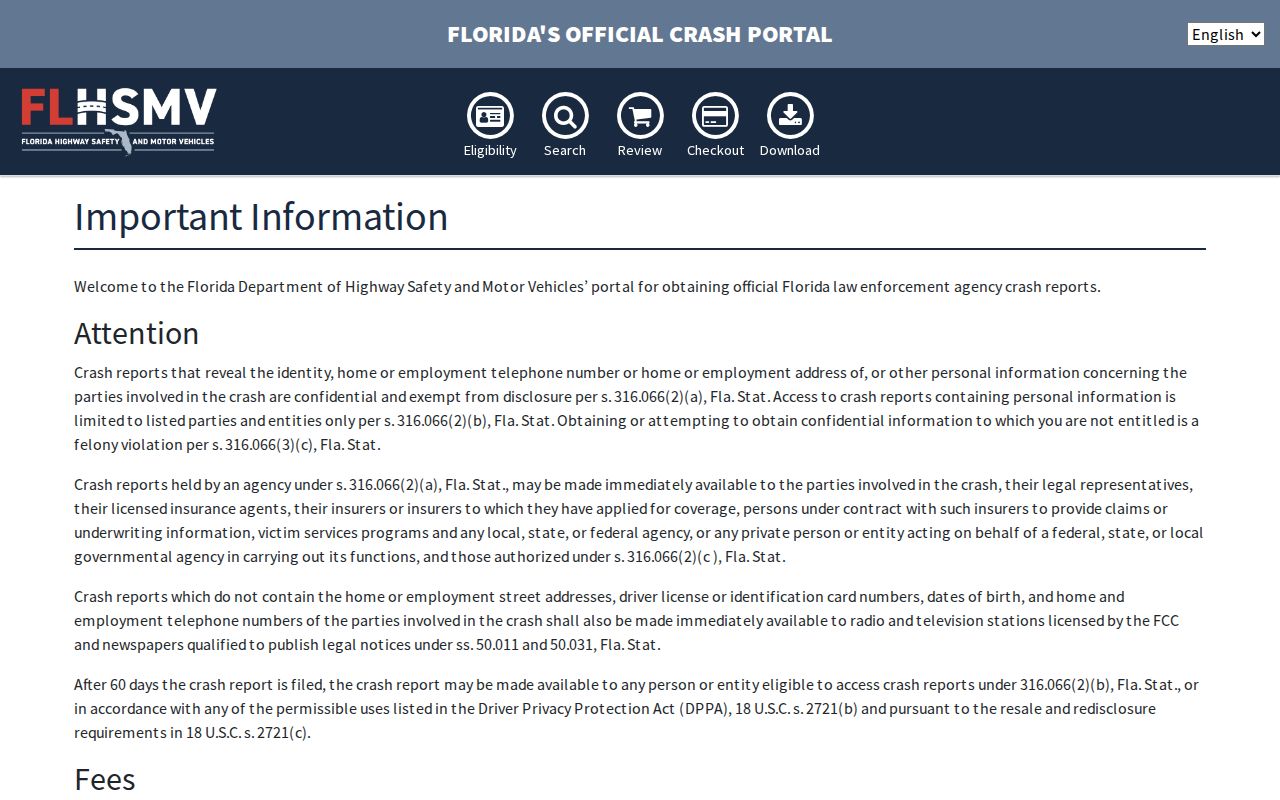
A crash report documents a traffic event. It is not an FDLE rap sheet, arrest report, or court disposition.
Body-camera video has more limits. Footage recorded inside a home, health facility, or another place with a reasonable expectation of privacy can be confidential. Separate requests may be needed for 911 audio, computer-aided dispatch entries, radio traffic, and video because different systems store them.
Note: Ask for incident reports, dispatch records, audio, and video separately because one Florida request may not retrieve every format.
Florida Public Access Laws
The Florida Constitution and Chapter 119 create a broad presumption of access to state and local records. A specific exemption can still require withholding or redaction. Custodians must acknowledge and respond in good faith, but the law does not promise a requester-set deadline. Remote court access may show less than counter inspection because judicial rules restrict certain documents and user roles.
FDLE may release adult intrastate criminal history for the statutory fee. Personal Review gives the subject a fingerprint-based route to inspect and challenge their own FDLE record. Sealed and expunged material, most juvenile history, grand-jury matters, active investigative information, protected victim facts, and sensitive personal identifiers remain outside routine public access.
Key Florida authorities:
Chapter 119 creates the public-record framework and lawful fee rules.
Section 943.053 governs public dissemination of Florida criminal history.
Section 943.056 provides personal review and challenge rights.
Florida Rule 2.420 sets the judicial-record access and confidentiality boundary.
Sections 943.0585 and 943.059 govern court-ordered expunction and sealing.
Florida Expunction and Sealing Records
Sealing and expunction are distinct Florida remedies. A sealed record becomes confidential from ordinary public access but remains available to the subject and agencies listed by law. With expunction, most agencies destroy or obliterate the covered record. FDLE keeps a confidential notation and specified access remains. Removing a web result from one clerk portal is not the whole process.
A common petition route begins with a certified county disposition. The applicant then seeks an FDLE Certificate of Eligibility with a fingerprint card, certified disposition, notarized material, and the $75 nonrefundable fee. That certificate only confirms eligibility to petition. It is not a court order and does not guarantee relief. The petition, affidavit, certificate, and proposed order go to the court that had jurisdiction over the case.
Florida also has automatic sealing for certain nonconviction records and special routes involving diversion, administrative errors, human-trafficking victims, and lawful self-defense. Eligibility depends on the exact charge, disposition, prior history, and statute. After an order, check both the county display and your FDLE Personal Review result.
Note: An FDLE eligibility certificate permits a petition to proceed, but only the Florida court can grant sealing or expunction.
Florida Criminal Offense Degrees
Florida uses degrees, not Class A, B, or C labels. Capital and life felonies sit at the top. First-degree felonies generally allow up to 30 years, second-degree felonies up to 15 years, and third-degree felonies up to five years. A first-degree misdemeanor generally allows up to one year in county jail. A second-degree misdemeanor generally allows up to 60 days.
Circuit courts hear felonies. County courts hear misdemeanors, criminal traffic, and county or municipal ordinance violations. Portal codes such as F1, F2, F3, M1, and M2 describe degree. Case suffixes such as CF, MM, and CT describe case type, not the sentence level. Enhancements and offense-specific statutes can change the range.
Read the filed count, offense statute, judgment, and sentencing records together. A booking charge may change. A withhold of adjudication is not an acquittal. “Nolle prosequi” means the State Attorney discontinued a charge. “No information” means the prosecutor did not file an information on the referred charge.
Florida Criminal Record Fees
Costs depend on the custodian and product. The public CCHInet transaction is $24 plus a $1 card fee. An FDLE certified or non-certified demographic search is $24. Personal Review has no FDLE fee, though a local agency may charge to roll fingerprints. A standard authorized Florida and FBI fingerprint check is $36 before a LiveScan provider's capture charge. The authorized ORI controls routing and category.
| Florida Record Product | Statewide Amount |
|---|---|
| CCHInet instant search | $25 total |
| Certified or non-certified FDLE search | $24 |
| FDLE Personal Review | $0 FDLE fee |
| Ordinary state and FBI check | $36 plus provider |
| Seal or expunge eligibility certificate | $75 |
| Clerk standard photographic copy | $1 per page |
| Clerk court-record certification | $2 |
Chapter 119 permits up to 15 cents for a standard one-sided copy when no other fee applies, plus authorized certification and extensive-service charges. County filing, postage, search, and vendor fees can add to the listed state amount. Confirm the total before ordering.
Note: Statewide fees do not include every lawful county, mailing, certification, or LiveScan provider charge that may apply.
Criminal Records by County in Florida
Florida's 67 constitutional clerks keep trial-court files county by county. Sheriffs and municipal police keep local arrest reports, while county detention systems hold booking and custody data. The largest metro counties show why one state search cannot replace local sources. Each county below has its own site for reaching the proper clerk, sheriff, jail, and police records channel.
Miami-Dade County
Miami · Florida's largest county and trial-court caseload
Broward County
Fort Lauderdale · Major jail and 17th Circuit records
Palm Beach County
West Palm Beach · Large clerk and sheriff systems
Hillsborough County
Tampa · 13th Circuit and local booking records
Orange County
Orlando · 9th Circuit metro record routes
Duval County
Jacksonville · Separate court and sheriff records
Pinellas County
Clearwater · 6th Circuit county record custody
Lee County
Fort Myers · 20th Circuit local record systems
Browse the full directory of all 67 Florida counties to open the criminal records site for any county.