
What the Florida Department of Law Enforcement Is
The Florida Department of Law Enforcement is the central repository for Florida criminal history information. Its Division of Criminal Justice Information Services, often called CJIS, runs the Criminal Justice Information Program. Florida Statutes section 943.051 directs that program to collect, process, store, maintain, and disseminate criminal justice information. Fingerprints are the base of the state record. That makes FDLE more than a web search provider. It is the state link between records created by local justice agencies and the person-centered Florida rap sheet.
FDLE has five broad program areas. Criminal Justice Information is the part most relevant to a record check. Within CJIS, Applicant Services handles public and ORI-routed checks, Biometrics Services processes fingerprints, the Crime Information Bureau supports CCH and FCIC operations, and Criminal History Record Maintenance handles review and correction work. The same department also operates criminal investigations and forensic services, professional standards, Capitol Police, and business support. These functions share an agency, but a public CCHInet search is not the same product as a law-enforcement inquiry through a restricted system.
FDLE CJIS and Florida Records
Three system names mark different parts of FDLE's work. Computerized Criminal History, or CCH, is the fingerprint-based chronological file of Florida arrests, dispositions, and incarceration information. The Florida Crime Information Center, or FCIC, is the secure network used by criminal justice agencies for CCH, wanted-person, and related operational files. FALCON is Florida's Integrated Criminal History System. It joins criminal history and biometric functions for authorized users and is not a public search portal.
FALCON also supports retained applicant fingerprints when a law permits retention. An authorized organization can manage those prints, receive notice when retained prints match an incoming Florida arrest, or end retention when its legal basis expires. FDLE is Florida's interface to FBI criminal history systems, so a legally authorized state-and-national submission passes through FDLE. That role does not turn the ordinary public Florida name search into a national search. Product and authority determine the scope.
Note: FALCON and FCIC are restricted justice systems, while CCHInet is FDLE's separate public demographic-search product.
FDLE Criminal History Check Options
FDLE offers distinct products for distinct legal purposes. CCHInet is an immediate public demographic search of Florida information under section 943.053, Florida Statutes. A staff-processed certified or non-certified search is also name based and arrives by mail. Personal Review is reserved for the subject or a designated attorney and uses fingerprints to identify the correct Florida file. A LiveScan check requires a lawful requesting entity and its ORI. The public cannot convert that channel into a general search of another person.
| Product | Who May Order | What It Returns | Cost |
|---|---|---|---|
| CCHInet Instant Search | Any member of the public | Public Florida CCH result based on demographic matching; not certified | $24 plus $1 card fee |
| Certified or non-certified search | Any member of the public | FDLE staff demographic search, with a notarized option, returned by mail | $24 |
| ORI-routed check | A person directed by an authorized Florida entity | Scope and result route set by the authority attached to the ORI | Varies by statute and ORI |
| Personal Review | The record subject or designated attorney | Fingerprint-verified copy of the subject's own Florida record for review | No FDLE fee |
| Personal Review challenge | The record subject | FDLE coordinates a validated correction with the originating office | No FDLE fee |
| Compromised Identity Review | A person whose identifiers may appear on another person's arrest record | Fingerprint comparison and coordination with local law enforcement | No fee stated |
| State and national LiveScan check | A person directed by a legally authorized entity with an ORI | Florida and FBI fingerprint results routed to the authorized recipient | Usually $36 plus provider charge; statutory categories vary |
| VECHS employee-type check | A qualified entity under the program | Florida and FBI fingerprint history for the authorized program | $36 plus provider charge |
| VECHS volunteer check | A qualified entity under the program | Florida and FBI fingerprint history for the authorized program | $28 plus provider charge |
| Fingerprint retention | Authorized noncriminal justice organization | Ongoing comparison with incoming Florida arrest prints | $6 yearly after the free first year |
| Seal or expunge Certificate of Eligibility | The subject seeking court relief | Eligibility determination only; the court decides the petition | $75 |
The official FDLE fee chart remains the source for a current ORI category. A Certificate of Eligibility for sealing or expunction is another FDLE service, not a criminal history check. It costs $75 and only determines eligibility to petition a court.
FDLE CCHInet Fields and Limits
CCHInet Instant Search takes a user through payment information, search criteria, confirmation, payment, candidates, and results. Last name, first name, race, sex, and date of birth are required. Middle name, suffix, aliases, and a full Social Security number are optional aids. If a Social Security number is used, the result shows only its last four digits. Billing details and an email address are also required. Email delivery of the result and receipt is selected by default but can be changed.
| Field | Type | Required | FDLE note |
|---|---|---|---|
| Terms acknowledgment | Checkbox | Yes | Required before Start Search |
| Billing name and address | Text and selections | Where marked | Entered during the payment step |
| Email address | Yes | Receipt and result or response are sent here | |
| State or province | Dropdown | Yes | Use Other outside the United States or Canada |
| ZIP or postal code | Text | Yes | Use 00000 outside the United States or Canada |
| Last and first name | Text | Yes | Names and suffix share a 46-character limit |
| Middle name and suffix | Text or selection | No | Can narrow demographic candidates |
| Race, sex, date of birth | Selection and date | Yes | Date accuracy strongly affects matching |
| Social Security number | Text | No | Must be complete if entered; only last four digits display |
| Aliases | Yes/No plus name fields | No | Adds maiden, nickname, or other known names |
| Automatic result and receipt email | Checkboxes | No | Selected by default and may be cleared |
| Receipt-copy address | No | Sends another receipt after payment |
A card payment begins a 30-minute candidate-selection session. Choosing another candidate costs another $25. "None of the Above" is a final response and does not refund the fee. CCHInet is Florida-only and name based. A likely name match is not positive identification. Print or email the result, then verify a disputed event against fingerprints and the original county source.
Note: Selecting another CCHInet candidate creates another charge, even when the first Florida candidate was not the correct person.
How Records Reach FDLE
A Florida arrest begins with a sheriff, municipal police department, Florida Highway Patrol, FDLE, or another authorized agency. At a qualifying booking, the agency captures fingerprints, palm prints, a facial image, and arrest data. The electronic transaction includes an Offender Based Transaction System number. That OBTS identifier follows the arrest cycle so a later court result can be linked to the right event rather than to a similar name.
Data flow: County Arrest › Fingerprint Submission › Florida Department of Law Enforcement › Court Disposition Reporting › Rap Sheet
The State Attorney decides whether to file charges. Circuit courts handle felony cases, while county courts ordinarily hear misdemeanors. The elected clerk owns the official docket and must transmit uniform dispositions to FDLE at least monthly. FDC also submits biometric data when it receives a person sentenced to a state institution. A record may still lack an outcome because a disposition was late, rejected, or not tied to the correct OBTS cycle.
A notice to appear, direct-file case, or sworn complaint may exist at the clerk without a booking fingerprint in CCH. For that reason, use the Florida county directory when a statewide entry conflicts with the local docket. The repository and county file describe related events, but they are not copies of each other.
FDLE LiveScan, ORI, and TCN
Florida does not appoint one exclusive fingerprint vendor for every authorized check. Instead, FDLE publishes a list of registered LiveScan submitters. Registration shows technical compliance, not an FDLE endorsement. Before an appointment, obtain the complete Originating Agency Identifier, or ORI, from the agency that requires the check. The ORI establishes the legal authority, fee category, scope, and destination of the result. FDLE cannot choose that code for the applicant.
The LiveScan provider verifies identity, enters the ORI and demographic data, captures the fingerprints, and sends the transaction. Keep the receipt and Transaction Control Number, or TCN. The complete TCN can be used in the CWCS status tool. Results go to the ORI-authorized agency, not to the provider and not directly to the person. Questions about the decision or result therefore belong with the requesting authority.
- Get the full ORI and instructions from the requesting agency.
- Choose a submitter from the FDLE registered LiveScan list.
- Confirm identification, photo, appointment, and provider-fee requirements.
- Keep the TCN after electronic fingerprint capture.
- Ask the ORI agency for the result and next action.
Note: The ORI sets legal authority and result routing; the LiveScan provider cannot choose or replace that code.
Ordering a Check From FDLE
Start with purpose and scope. Use CCHInet when a public, Florida-only name search meets the need. Choose the staff-processed option when the result must be mailed or notarized. Use Personal Review when checking the accuracy of your own FDLE record. A fingerprint check is available only when a statute and authorized ORI support it. These channels are not interchangeable, and none produces the underlying county pleadings or arrest narrative.
- Select CCHInet, staff processing, Personal Review, or an ORI-authorized LiveScan check.
- Gather the required names and demographics, or the official fingerprint form and card.
- Submit online, by mail, or through a registered LiveScan provider as the product directs.
- Pay the stated FDLE fee and any separate provider capture charge.
- Read each result as a summary, then obtain the county court file for a disputed or detailed event.
CCHInet results are normally immediate. FDLE lists five business days for a non-certified staff search and six to seven business days for a certified search, plus mail time. Personal Review can take up to 30 working days. A provider's appointment schedule and rolling charge are separate from FDLE processing.
FDLE Fingerprints Confirm Identity
A demographic search can return candidates with similar names and birth dates. FDLE warns that only a fingerprint comparison makes positive identification. This is why CCHInet lets a user compare candidate details but does not certify that a chosen candidate is the searched person. The distinction also explains why Personal Review requires a fingerprint card taken by a law-enforcement or criminal justice agency.
Identity rule: Treat a name match as a lead. Use FDLE Personal Review and original county records to resolve a suspected mismatch.
Fingerprint association also gives an arrest cycle its state identity. Yet fingerprints cannot create an event that was never submitted. A direct-file prosecution without booking may appear only in a clerk docket. A missing court disposition can leave the CCH arrest open-ended. Fingerprint identity and record completeness answer different questions, so both must be checked.
County Records vs FDLE Checks
An FDLE check is the statewide person-centered view. A county file is the source-centered view of one arrest or prosecution. CCH can connect fingerprint-supported cycles from all 67 Florida counties. The county clerk, jail, or arresting agency can show newer entries, event details, and documents that never belong on a rap sheet. Neither source replaces the other. Use the county directory to find the office that created the local record.
| FDLE Check | County Records | |
|---|---|---|
| Coverage | Reported Florida CCH events across 67 counties | Arrests or cases created in one county |
| Source | Fingerprint-backed repository chronology | Original docket, booking record, or incident report |
| Freshness | Depends on agency and clerk reporting | Often updates as booking or case events occur |
| Detail | Arrest, charge, disposition, and custody summaries | Pleadings, orders, hearings, bond, narrative, and local status |
| Best for | A statewide Florida history overview | Confirming the event, current status, and source documents |
FDLE History and Digital Records
Florida combined the Sheriffs Bureau, State Narcotics Bureau, and Attorney General's Anti-Bookie Squad into the Bureau of Law Enforcement in 1967. The new bureau began with 94 positions and a $1.5 million first-year budget. State reorganization renamed it the Florida Department of Law Enforcement in 1969. Criminal Identification and Information was one of its four divisions and became a direct ancestor of today's CJIS structure.
The modern repository and reporting framework took shape through 1980 legislation. FALCON modernization later joined CCH and biometric functions, and Florida's Biometric Identification Solution entered service in 2009. FDLE ended its mailed Florida Criminal History Information Request form in July 2020. A redesigned, mobile-friendly CCHInet launched that October. The shift made name results faster, but it did not alter the core limits: public CCHInet remains demographic, Florida-only, and dependent on records reported to FDLE.
Scale is substantial. FDLE reported more than 1.48 million Level 1 and 1.61 million Level 2 checks during 2024. Those totals count processed checks, not unique people. The public CCH analytics dashboard covers about ten arrest years and refreshes monthly on the fifth from data received through the first.
Note: FDLE check totals measure processed transactions, not unique people or the number of Florida residents with records.
FDLE and FBI Record Boundaries
A $25 CCHInet transaction searches public Florida CCH information. It does not add criminal history held only by another state or the federal government. An authorized Florida state-and-national LiveScan check can include FBI information because a valid ORI and statute permit that route. Its result goes to the authorized recipient. These rules prevent a general public name search from becoming an unrestricted national fingerprint check.
For a copy of your own national fingerprint record, the FBI electronic Identity History Summary is the direct subject-only channel. The federal fee is $18 before postal capture or channeler costs. Federal criminal case dockets are separate again and are searched through PACER, while federal custody is searched through the Bureau of Prisons. FDLE, FBI, federal courts, and BOP hold different slices.
The practical test is simple. Use CCHInet for public Florida history, Personal Review for your fingerprint-verified Florida file, FBI eDO for your own national summary, and the county clerk for the original Florida trial record. No single one of these systems supplies every layer.
Fixing Errors in an FDLE Record
Florida Statutes section 943.056 gives a person access to a fingerprint-verified copy of their own FDLE record and a way to challenge accuracy or completeness. Common problems include a missing disposition, a cycle linked to the wrong identity, or an entry that does not reflect a later sealing or expunction order. Personal Review has no FDLE fee and can produce a no-record response when no Florida file is found.
- Complete the Personal Review form and have a law-enforcement or criminal justice agency take the fingerprints.
- Mail the signed form and fingerprint card to FDLE Criminal History Record Maintenance.
- Compare the returned record with certified dispositions and source records from the county that handled each event.
- Identify the inaccurate item and send supporting records through the FDLE challenge process, then confirm the correction on a later copy.
The originating court or agency decides what its source record should say. FDLE then conforms CCH after the correction is validated and requests a matching federal correction when appropriate. Criminal History Record Maintenance can be reached at (850) 410-7898 or chrm@fdle.state.fl.us. A compromised-identity claim uses a separate fingerprint comparison process when someone else's arrest history contains the claimant's identifiers.
The FDLE Personal Review instructions show the fingerprint and mailing route used for a self-review.
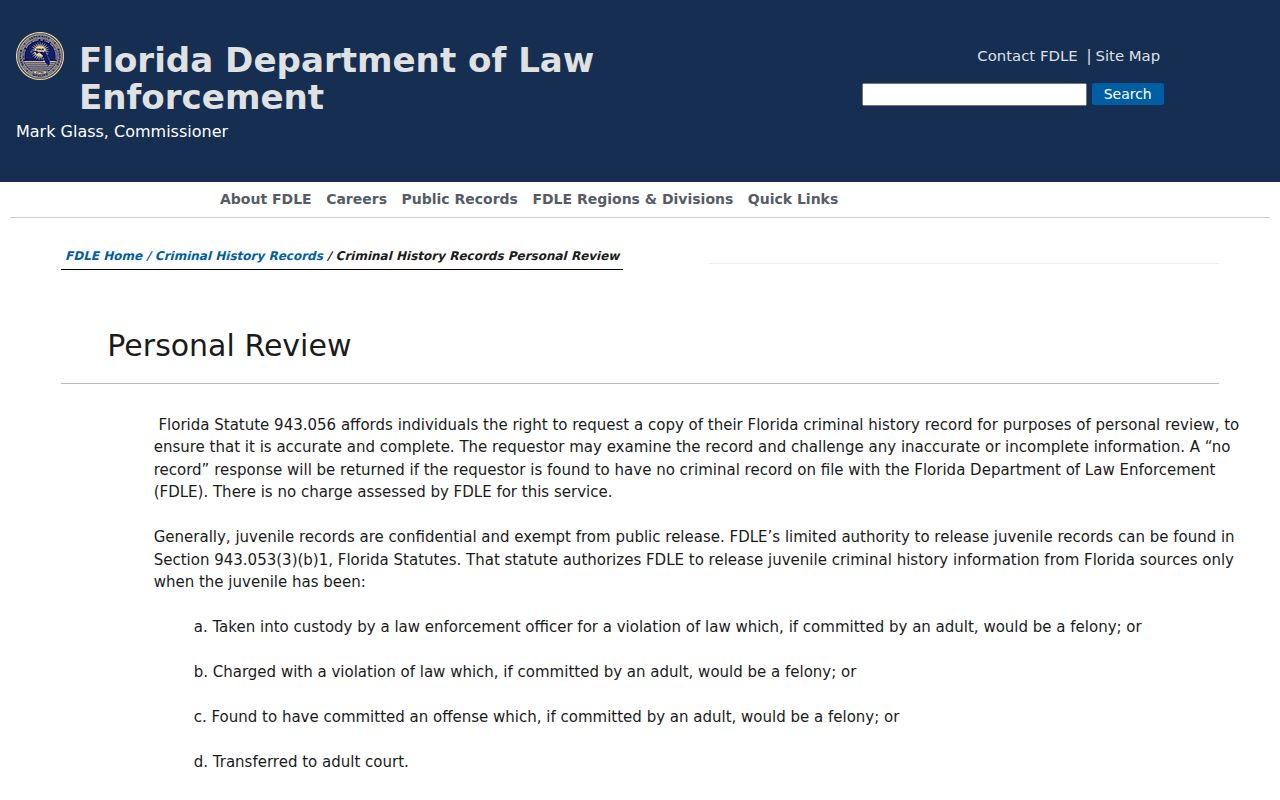
This official screen reinforces that Personal Review is the correct path for verifying and challenging your own Florida record.
When the suspected gap is national, the FBI electronic request portal provides a separate subject-only fingerprint channel.
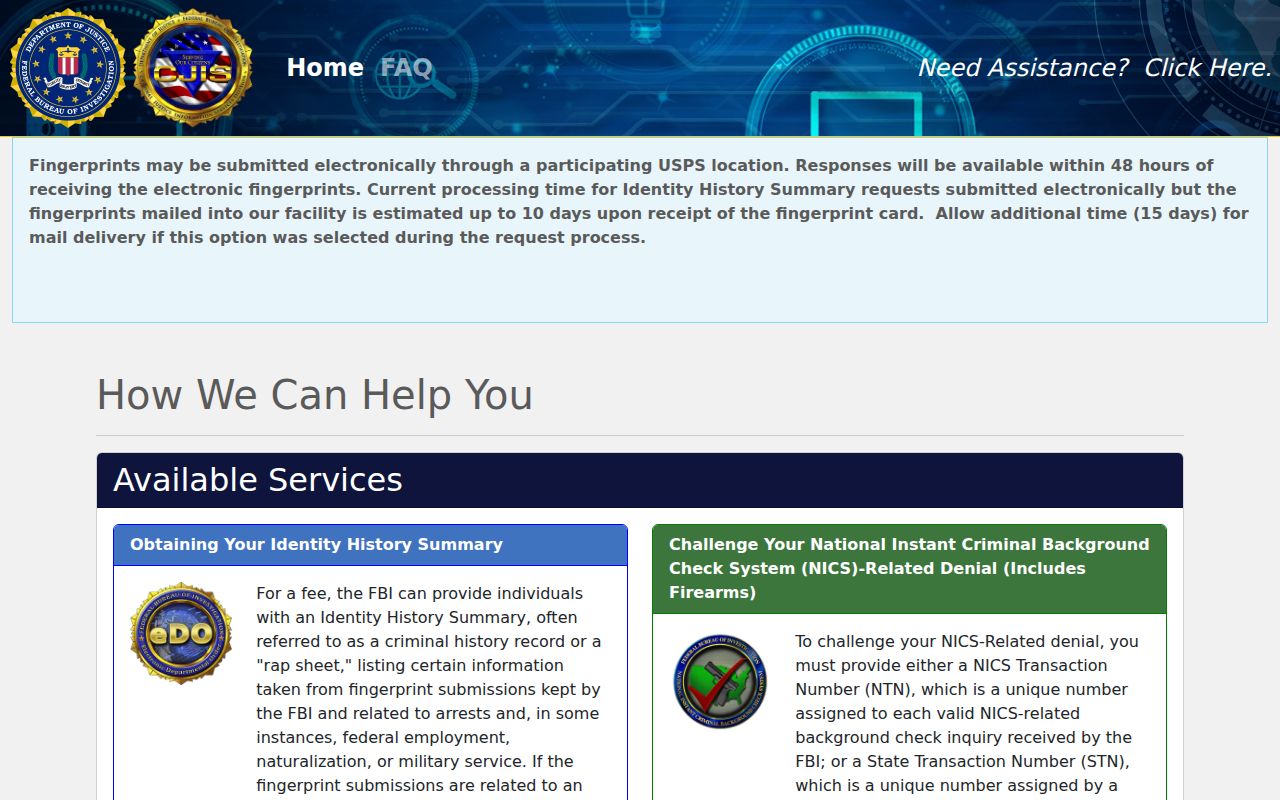
The federal portal belongs after the FDLE review when the question extends beyond Florida's repository boundary.