
Florida Arrest History
A Florida arrest can produce several records held by different custodians. A sheriff, municipal police officer, Florida Highway Patrol trooper, FDLE agent, campus officer, or another authorized officer creates the incident or arrest report. If booking follows, the county jail records intake time, an agency charge, bond, holds, identifiers, and release data. Those county records are usually the first official source for a recent arrest.
A qualifying booking also sends fingerprints and arrest data to the Florida Department of Law Enforcement. FDLE connects the transaction to a State Identification number and adds later dispositions when criminal justice agencies report them. The county clerk opens a separate case if prosecutors file charges. Thus, one Florida arrest history may appear as a jail entry, an agency report, a court docket, and an FDLE arrest cycle. Each record answers a different question. None alone is the full story.
Four Florida Arrest Records
The four-record model prevents a common Florida arrest lookup error. A police report describes the alleged event and investigation. A booking record documents local intake and current custody. A court file shows the charge the State Attorney actually pursued and the court's outcome. FDLE CCH arranges reported, fingerprint-linked arrest cycles across Florida.
Identifiers keep those sources straight. A county booking number belongs to one local intake. A TCN identifies one fingerprint transaction. A Florida SID connects fingerprint-supported events to one state identity. An FDC DC number belongs to a person in the Florida Department of Corrections system. Substituting one number for another can lead to a false match or a dead-end request.
- Booking number
- The county jail's identifier for one intake.
- TCN
- The transaction control number assigned to a fingerprint submission.
- SID
- Florida's durable state identity number tied to fingerprints.
- DC number
- The FDC identifier for state prison or supervision records.
Note: Florida booking numbers, TCNs, SIDs, and DC numbers belong to different systems and should never be treated as substitutes.
How Florida Arrests Reach the Record
Florida law directs FDLE's Criminal Justice Information Program to maintain biometric and criminal history systems. At booking, LiveScan fingerprints and arrest details are sent to FDLE and assigned a transaction control number. Fingerprints establish the match. A similar name does not. If the State Attorney files a charge, the circuit or county clerk creates the court docket. The clerk and other criminal justice agencies later report the disposition so FDLE can complete the arrest cycle.
Data flow: Arrest › Fingerprints › Florida Department of Law Enforcement › Disposition Reporting
Gaps still occur. FDLE says events based only on a notice to appear, direct-file information, or sworn complaint may be absent unless fingerprints were later taken. Delayed submissions, rejected fingerprints, identity mismatches, and unreported outcomes also matter. A county docket can show hearings or orders that CCH lacks. CCH may connect arrests from several counties that no single clerk can see.
The FDLE CCH dashboard illustrates the repository layer used to study Florida arrest history reporting.
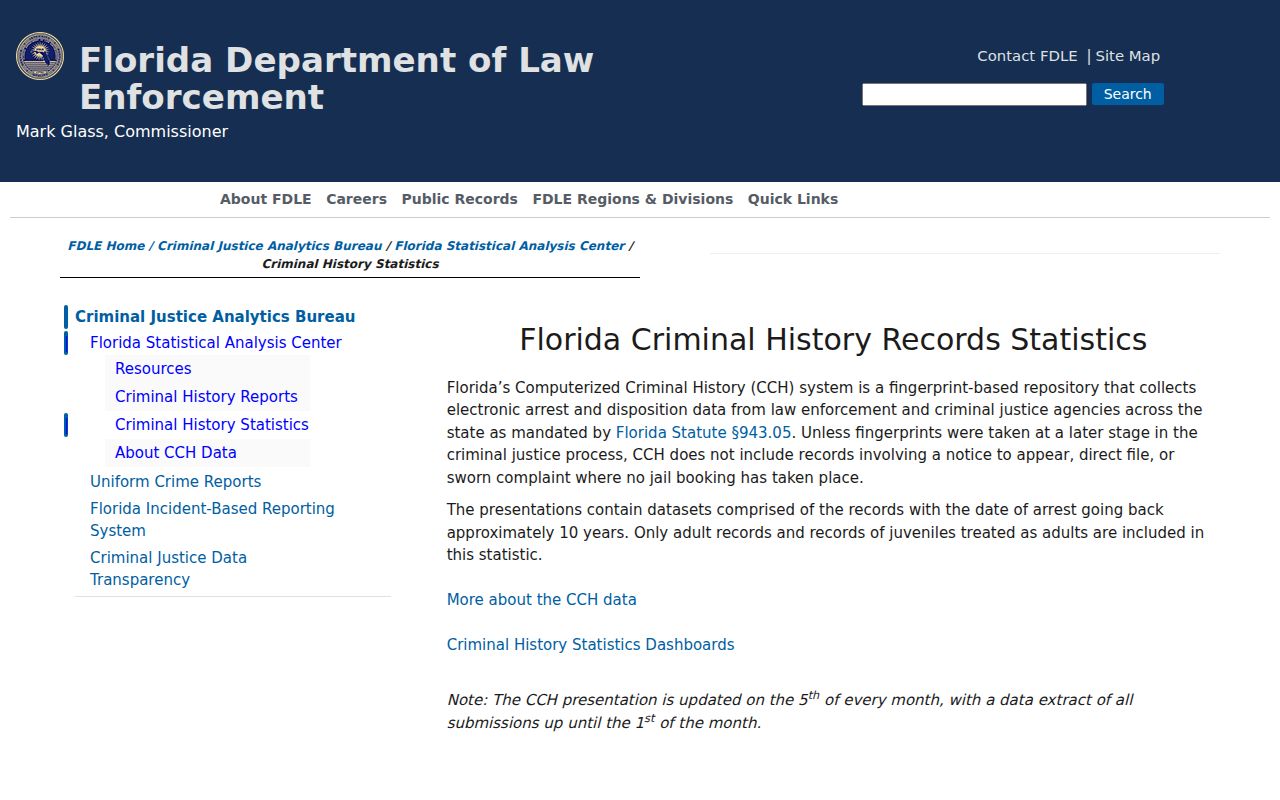
That statewide view measures repository activity, while a person's original booking and case remain with the county sources that created them.
Florida Arrest Counts in Context
FDLE's last complete statewide summary-UCR comparison reports 543,138 arrests in 2021. It separates 513,938 adult arrests from 29,200 juvenile arrests. It also reports 90,199 Index or Part I arrests and 452,939 Part II arrests. Selected categories include 78,437 drug arrests, 76,711 simple-assault arrests, and 33,750 DUI arrests.
These are arrest events, not unique people and not convictions. Reporting methods also changed as Florida moved from summary data to incident-based reporting. Some agencies supplied summary figures, others supplied incident data, and some could not report. A later partial dashboard total should not be compared with the complete 2021 table without checking participation and coverage.
The official Florida arrest and offense dashboard provides the source interface for statewide counts.
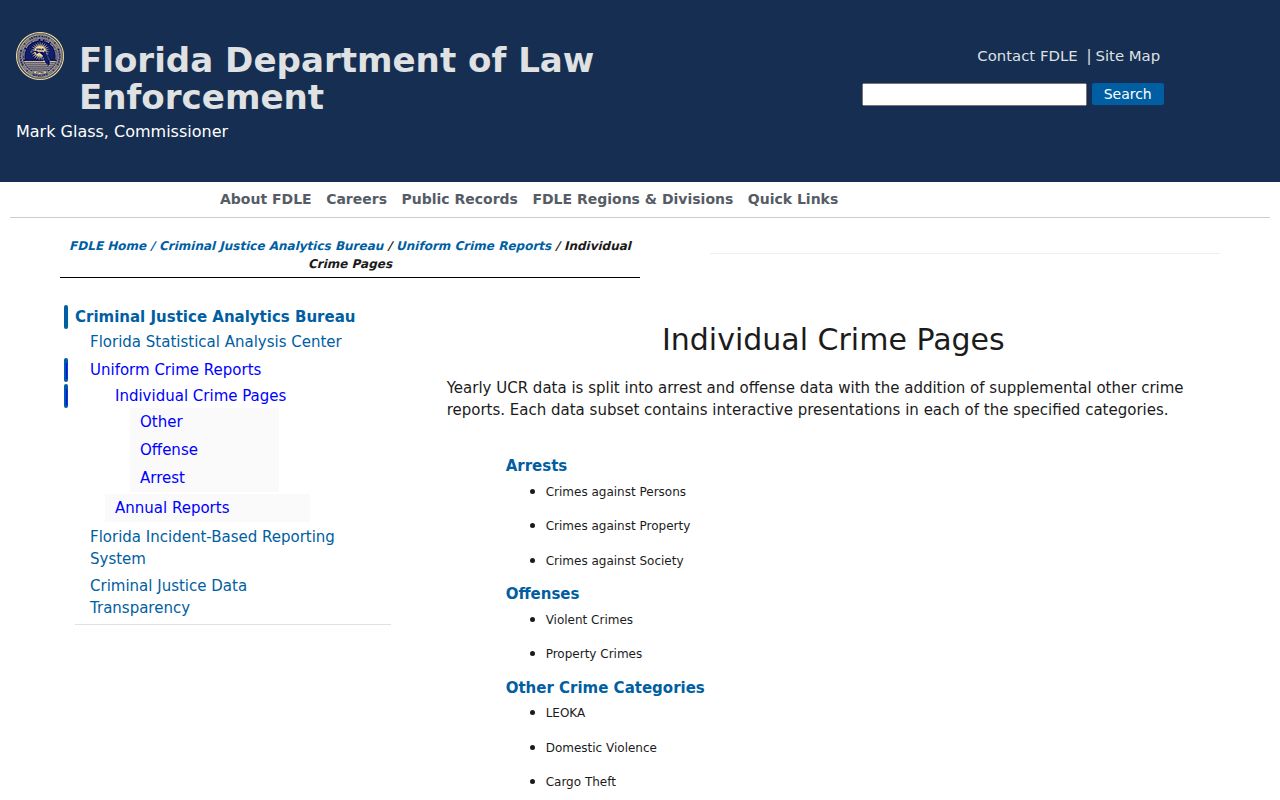
The dashboard gives statewide context, but it cannot prove anything about a person or replace an official Florida arrest record.
Note: Florida arrest totals count reported events, not unique people, proven offenses, convictions, or a complete measure of community risk.
Looking Up Arrests in Florida
Start at the record closest to the event. Florida has no unified county-jail roster. Recent bookings, jail custody, blotters, and local release facts must be checked county by county. FDLE CCHInet is the broader Florida arrest history source, but it is not a real-time booking log. The $24 statutory search plus $1 card fee applies even when the search returns no record, and a name result is not fingerprint-positive identification.
- Identify the arrest county and open its official jail or corrections roster for the newest booking and custody facts.
- Request the incident or arrest report from the creating agency using the case number, date, place, and record type.
- Use the directory of all 67 Florida counties to reach the right jail, sheriff, police records unit, and clerk.
- Check the county court docket after filing, then use FDLE CCHInet when a statewide, multi-county history is needed.
Older or non-imaged records may require a clerk counter request, mail, or email under local procedure. An FDLE public-record request is another channel for records created by FDLE itself. Describe the agency, county, approximate date, case or arrest number, and record type to reduce delay and special-service costs.
Florida Arrest Custody Changes
A recent arrest starts as a county custody question. County jails hold people awaiting trial, serving many local sentences, awaiting transfer, or held on warrants and detainers. FDC begins to matter after a state sentence or when a person enters state felony supervision. Someone held only in a county jail or serving county probation will not appear in the state locator.
The free FDC Corrections Offender Network searches by name or DC number and may show state prison, release, and community-supervision data. Status can change quickly. Federal custody is separate and belongs in the federal Bureau of Prisons locator.
The official FDC search interface shows where a Florida arrest lookup changes into a state corrections search.
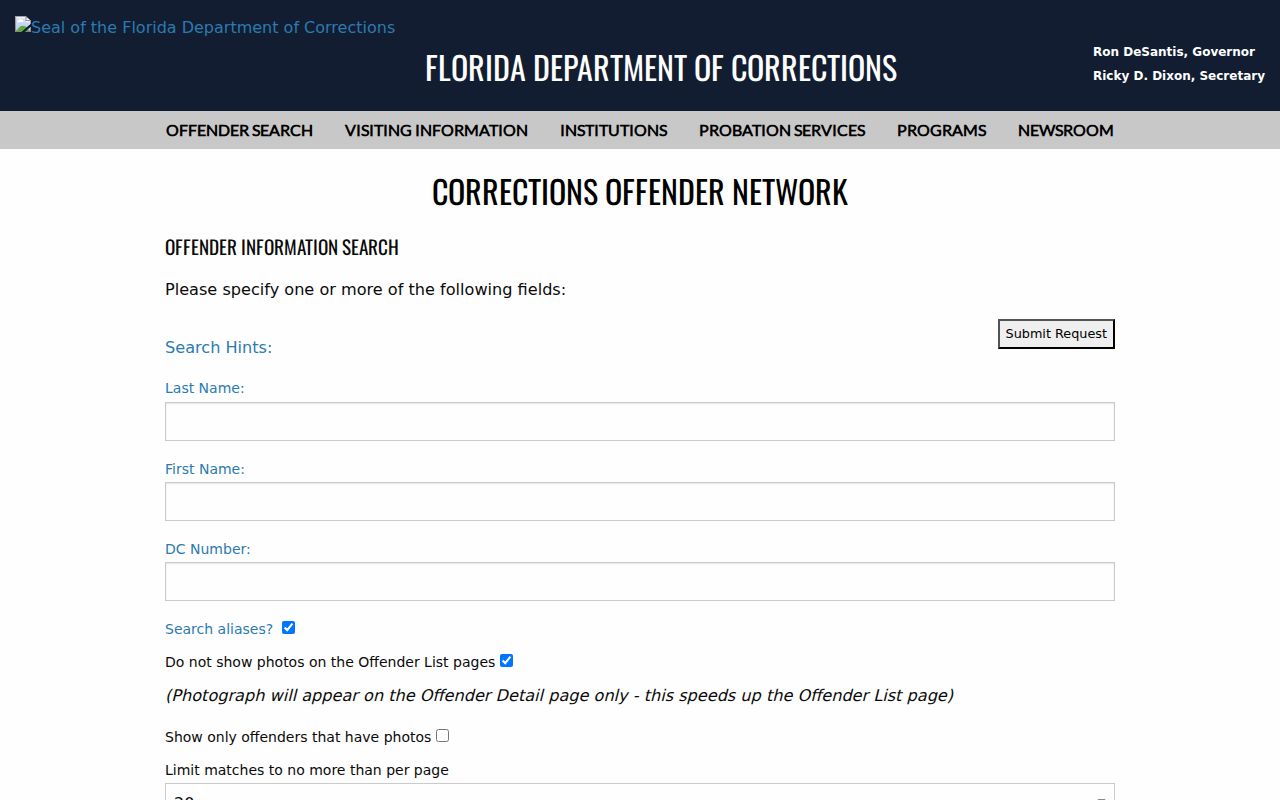
Use it only after the record points to FDC custody or supervision; it excludes the many people held solely in Florida county jails.
Florida Arrest Photo Boundaries
A booking photo may be a public record when no exemption applies, but release practices differ among Florida counties. Section 901.43 targets a separate problem. It bars covered commercial publishers from soliciting or accepting payment to remove booking photographs. After a qualifying written request, a covered publisher must remove the image without charge within ten days and must not republish it.
That law does not make every government booking image confidential. Public access still depends on the official custodian, the record's status, and applicable exemptions. Juvenile delinquency and arrest material follows much tighter rules under chapter 985 and court access standards. A current adult jail photograph also proves only that an image was associated with a booking. It does not prove the charge survived review or ended in conviction.
Use the official record to identify the right person, then check the clerk's disposition. Do not rely on copied images, stale reposts, or private mugshot sites. They can omit release data, corrections, and later court outcomes.
Note: A booking photograph documents one intake image; it does not establish that prosecutors filed the booking charge or that guilt followed.
Inside a Florida Arrest Record
A Florida arrest record identifies an alleged event and its processing. The exact display varies by custodian. An agency report may include probable-cause facts, evidence, and property subject to exemptions. A jail view focuses on booking, holds, bond, and release. The FDLE cycle emphasizes a fingerprint-supported chronology. The county docket supplies the filed charge and final outcome.
| Name & Identifiers | Reported name, aliases, descriptors, date of birth, SID, TCN, or local booking number as allowed. |
|---|---|
| Arrest Date & Place | The date, time, location, and warrant, probable-cause, or notice-to-appear basis. |
| Arresting Agency | The sheriff, municipal police, FHP, FDLE, or special agency that created the arrest record. |
| Booking Charges | Initial alleged offense, statute, degree, count, and agency case number, which prosecutors may later change. |
| Booking Details | Intake number and time, descriptors, jail location, holds, and a photograph when lawfully released. |
| Bond & Release | Bond type or amount, release method, and release date where the custodian publishes them. |
Protected personal identifiers are suppressed. Active investigative details, juvenile information, victim identities, and other exempt material may also be withheld or redacted. Absence from a web view does not prove the source office has no responsive record.
Missing Florida Arrest Outcomes
If your own FDLE arrest cycle lacks an outcome, first get the county clerk's certified disposition. Then use FDLE Personal Review. It is a free, fingerprint-verified process available only to the record subject or a designated attorney. The signed form and fingerprint card go to FDLE, and the response may take up to 30 working days.
Identify the inaccurate or incomplete item and provide source documents. The originating court or agency decides what its own record should say. FDLE can then conform CCH and request a related federal correction. This route is safer than guessing from a name-only public result.
Own-record correction: A CCHInet search cannot positively identify a person. Fingerprint-based Personal Review is the official Florida route for checking and challenging your own FDLE record.
Arrests vs Convictions in Florida
An arrest records an accusation and custody event. It does not establish guilt. A conviction is a court judgment after a plea or verdict. Florida also uses outcomes such as acquittal, dismissal, no information, nolle prosequi, and adjudication withheld. A withhold is not an acquittal, and it may remain visible unless legal relief applies.
| Arrest Record | Conviction Record | |
|---|---|---|
| Created by | Arresting agency and county jail. | County or circuit court judgment, later reported to FDLE. |
| What it proves | An arrest or booking occurred on an allegation. | Guilt was adjudicated after a plea or trial. |
| Best source | Agency report, jail entry, and FDLE arrest cycle. | County clerk judgment and disposition. |
| Record relief | Eligible nonconviction history may qualify for sealing, expunction, or automatic sealing. | Relief is narrower and depends on the exact judgment and statutory eligibility. |
Note: A Florida arrest with no displayed disposition is not proof of guilt; confirm the result in the county court file.
Florida sealing and expunction are court processes, not simple removal from one website. Eligibility turns on the outcome, prior history, and statutory exclusions. A common petition route starts with a certified county disposition, then an FDLE Certificate of Eligibility where required, followed by filing in the court that handled the case.