
Criminal Court Cases in Florida
Florida has two trial-court levels. The state's 20 circuit courts have general jurisdiction over capital, life, first-degree, second-degree, and third-degree felonies. They also hear juvenile delinquency matters. The 67 county courts handle misdemeanors, criminal traffic cases, and county or municipal ordinance violations. A first-appearance hearing may be conducted by a circuit or county judge designated by the chief judge.
Each Florida county elects a Clerk of the Circuit Court and Comptroller. That clerk generally serves both the circuit and county courts, so one office holds felony and misdemeanor case files even though the cases belong to different court levels. The trial file includes the docket, pleadings, orders, judgments, and sentence. Appeals move to one of six District Courts of Appeal, with limited matters reaching the Florida Supreme Court. Court level and record custodian are distinct facts, and both matter when locating a criminal case.
| Court Level | Criminal Work | Record Route |
|---|---|---|
| Circuit Court | Felonies and juvenile delinquency | County Clerk of the Circuit Court |
| County Court | Misdemeanors, criminal traffic, ordinances | Same county clerk acting for county court |
| District Court of Appeal | Most appeals from circuit and county courts | DCA clerk and ACIS |
| Florida Supreme Court | Death judgments and limited specified review | Supreme Court clerk and ACIS |
Florida Criminal Cases Lack One Portal
Florida has no single public statewide search for circuit-court and county-court trial cases. Each elected clerk controls local trial records and usually operates a separate portal. Search rules, date coverage, result limits, and available document images can therefore differ. A name search in one county does not test the other 66 counties. Start with the county where the charge was filed, which may differ from the person's current home.
The Florida Court Clerks & Comptrollers directory routes users to the official clerk for every county. On a clerk portal, choose the criminal division that fits the matter: circuit criminal or felony, county criminal or misdemeanor, or criminal traffic. Search by case number when possible. Otherwise use a full first and last name, add a middle name, and narrow the filing dates. A missing web result is not conclusive because older files, protected matters, and records awaiting digitization may not appear remotely.
Note: A Florida judicial circuit may span counties, but each filing county's clerk keeps its own trial record.
Searching Florida Court Case Records
A Florida trial-case search uses the county clerk, while a statewide appellate search uses the Florida Appellate Case Information System. Keep those paths separate. ACIS covers the Supreme Court and all six District Courts of Appeal. It does not search felony, misdemeanor, or criminal traffic trial dockets. The county portal remains the primary source for those files.
- Identify the county where the criminal charge was filed.
- Open that county clerk's official portal and select the correct criminal case type.
- Search by uniform case number, or use the full party name and filing-date limits.
- Read the full docket for charges, hearings, orders, dispositions, and sentencing events.
- Request unavailable images, older files, or certified copies from the clerk in person, by mail, or through its records-request channel.
For an appeal, use the ACIS case search. Public dockets and public documents do not require registration. These are the documented ACIS fields:
| Field Label | Type | Required | Notes |
|---|---|---|---|
| Court | Dropdown | Unspecified | Supreme Court or First through Sixth DCA |
| Case Number | Text | No | Uses the YYYY-XXXX format |
| Case Title | Text | No | Accepts a title or keyword |
| Case Category | Dropdown | No | Options load after the court choice |
| Case Filed Date | Date range | No | Narrows by filing date |
| Originating Court Case Number | Text | No | Searches the lower-tribunal number |
| Limit to Open Cases | Checkbox | No | Excludes closed cases |
ACIS Tracks Florida Criminal Appeals
ACIS begins where the county trial docket leaves off. It searches appellate cases by court, case number, case title, category, filing date, or originating trial number. Results show the court, appellate case number, title, category, latest docket date, and open or closed status. Party results add the person's role and name. Public users may also search parties, oral arguments, documents, and publications.
The official Florida appellate portal provides a useful view of that statewide scope:
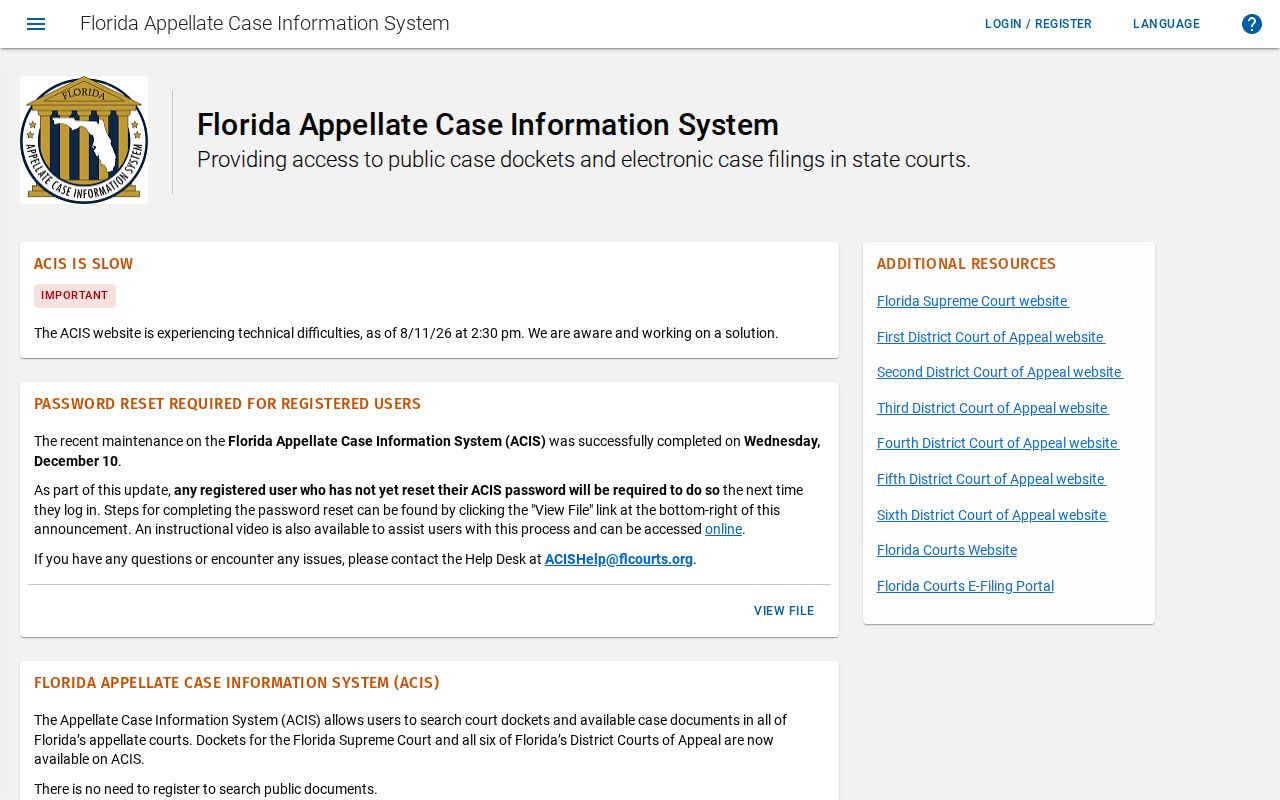
The interface identifies appellate cases across Florida, but it cannot replace a county clerk search for the underlying trial docket and documents. Attorneys, judges, lower-court clerks, and self-represented litigants may register for role-specific access, while ordinary public searching remains available without an account.
Inside a Florida Criminal Case File
A Florida criminal case file tells a different story from an FDLE criminal-history result. It follows one prosecution in one court. The docket can show each charge count, the state statute, bond activity, hearings, filings, orders, outcome, and sentence. Available images may include the information, plea, motion, verdict, judgment, probation order, or notice of appeal. Financial ledgers may list costs, fines, and restitution.
| Case Number & Court | Identifies the county, court type, filing year, sequence, and division as displayed by that clerk. |
|---|---|
| Charging Documents | May include a complaint, information, indictment, or notice tied to the filed counts. |
| Docket Entries | Chronological register of appearances, pleadings, motions, orders, warrants, and other recorded events. |
| Hearing Dates | Lists scheduled or completed first appearance, arraignment, pretrial, trial, and sentencing events. |
| Disposition | Reports the outcome of each charge, such as guilty, dismissed, acquitted, nolle prosequi, or no information. |
| Sentence & Judgment | Shows adjudication, incarceration, probation or community control, fines, and other ordered terms when public. |
FDLE's Florida Computerized Criminal History is a compiled, fingerprint-supported history organized around arrest cycles. It may link arrests from several counties, but it does not reproduce pleadings, hearing detail, or the full register of actions. The county case file is not a rap sheet. Neither source replaces the other.
Reading Florida Criminal Case Outcomes
Disposition text must be read charge by charge. One case can have several counts with different outcomes. “Adjudicated guilty” is a formal finding of guilt. “Adjudication withheld” means the court did not enter a formal adjudication, but the plea or finding remains a real event. It is not an acquittal. “Nolle prosequi,” often shortened to “nol pros,” means the State Attorney discontinued a charge. “No information” means the prosecutor formally declined to file an information on the referred charge.
- Disposition
- The recorded outcome of one charge, not merely the overall case status.
- Information
- The State Attorney's formal charging document commonly used in felony cases.
- Capias
- A court command to take a person into custody, often tied to a missed event or later ruling.
- Uniform Case Number
- A Florida convention encoding court type, year, sequence, and case type, with punctuation that can vary by clerk.
Common suffixes include CF for circuit felony, MM for county misdemeanor, and CT or TR for traffic categories. Confirm the legend on the clerk's own portal. A dismissed or acquitted count is not a conviction. The docket should also be checked for later orders, appeals, or record-relief activity before treating an early entry as the final result.
Note: Read each Florida charge count separately because one case can contain several different outcomes and dates.
How a Florida Criminal Case Moves
Florida Rule of Criminal Procedure 3.130 requires an arrested person who has not already been lawfully released to appear before a judicial officer within 24 hours. The judge addresses the charge, rights, counsel, probable cause, and release. The State Attorney then files an information, seeks an indictment where required, or declines the charge. Arraignment records the plea. Motions, discovery, and hearings build the pretrial docket. A plea or trial produces the disposition, followed by judgment and sentencing when applicable.
Case flow: Charges Filed › Arraignment › Pretrial › Plea or Trial › Disposition › Sentencing
Each stage creates a different record. The charging document states the accusation. The register of actions tracks filed events. Orders resolve motions. A verdict or plea resolves contested guilt, while the judgment states adjudication and the sentence states the penalty. Disposition data is later reported to FDLE under Florida law, but reporting gaps or rejected submissions can make the state history and county docket disagree.
Florida criminal dockets and FDLE records serve different purposes. Verify a case outcome with the county clerk that holds the original court file.
Florida Criminal Records and Rule 2.420
Florida court records are generally open under Rule 2.420, the state constitution, and applicable law, but public access does not make every document downloadable. The judicial branch's electronic standards assign access by document type and user role. Ordinary felony records are generally public subject to restrictions. Some felony sexual-case documents may be “viewable on request” while clerk staff remove protected victim details and personal identifiers.
Juvenile delinquency files are sharply restricted. Sealed and expunged cases are not ordinary public results. Grand-jury material, protected addresses, Social Security numbers, account numbers, specified victim identities, and minor information can be confidential or redacted. A portal may show a docket line while withholding its PDF. In that situation, use the clerk's request process or visit the courthouse counter. The clerk can explain access and copying procedures without changing a court-ordered restriction.
Note: A public docket line does not guarantee that its linked Florida court document is available for remote viewing.
A blank portal result does not prove that no Florida criminal case exists. Confirm spelling, county, date coverage, and non-web access with the clerk.
Older Florida Criminal Case Records
Online coverage varies because Florida trial portals are county systems. Some clerks provide decades of index data but fewer years of document images. Others impose result caps, require CAPTCHA, or place older material outside the web database. The research example from Orange County reports most index data from about 1990 forward and most documents from about 2009 forward, with a 500-result cap. Those dates describe one portal, not a statewide retention rule.
For an older Florida criminal case, first search the official county index using several formats of the case number and name. Then contact the clerk's criminal-records division for an archive search, inspection, or copy request. Requests may be made in person, by mail, or through the clerk's records channel when offered. Under Florida Statutes section 28.24, ordinary photographic copies are $1 per page, certification is $2 per instrument, and a records search is $2 per year. Postage, media, or extensive work may add authorized costs.
Case Records at the County Level
The full Florida trial file stays with the clerk in the county where the case was filed. A circuit can span several counties, but that does not merge their records into one portal. Use the filing county, not merely the judicial circuit number. The clerk can provide local docket access, permitted images, certified copies, older files, and instructions for in-person or mailed requests.
When the county is unknown, clues may appear in an arrest record, charging agency, citation, uniform case number, or ACIS originating-case field. Once identified, open the correct local source through the directory of all 67 Florida counties. County clerk access is the authoritative route for document-level trial research, while ACIS remains the source for statewide appellate dockets.
Note: Florida's county docket provides the original case detail, while FDLE CCH provides a separate compiled history based on reported arrest cycles.