
Running a Sex Offender Check in Florida
The Florida Department of Law Enforcement's Offender Registry Services Bureau maintains the public Florida Sexual Offender and Predator Registry. It is free, needs no account, and covers all Florida counties. FDLE compiles information reported by sheriffs, other law enforcement, FDC, courts, jails, state agencies, and registrants. FDLE does not independently verify every reported fact.
Florida uses two legal designations: sexual offender and sexual predator. The database is not a public risk score. A predator designation requires statutory criteria and a written court finding under the Florida Sexual Predators Act. Search results can include people in Florida communities, confined people, absconders, and people outside Florida who remain within the database's coverage. Read the status and conviction history before drawing any conclusion.
Florida Registry Radius Search
The neighborhood search begins with a Florida street address, city, and five-digit ZIP. The radius can be one-quarter mile, one-half mile, or one through five miles. Results may be displayed as a map or list. The list can include a transient or descriptive address that cannot be plotted precisely, so map and list totals may differ.
The official Florida registry map and public notice interface shows the portal's geographic tools and marker meanings.
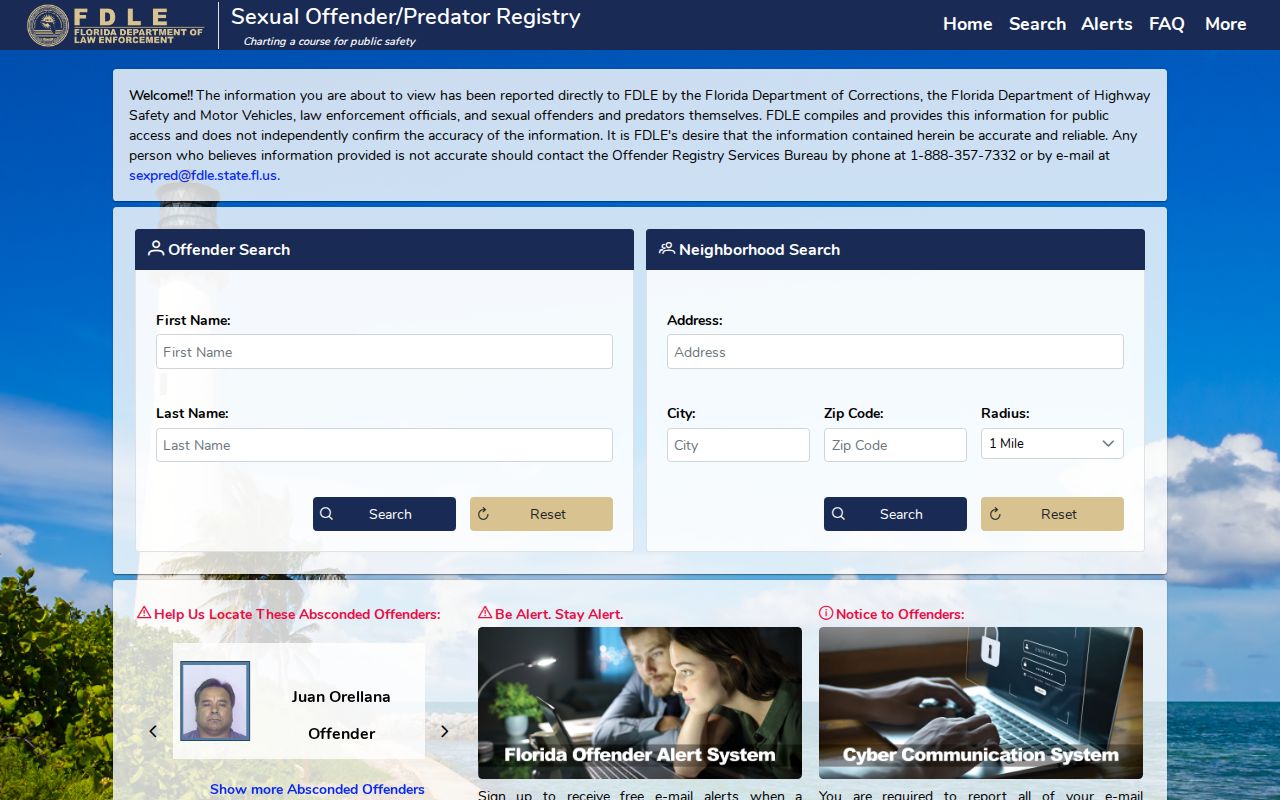
A marker identifies a reported registry location, not a finding about current conduct or risk. Open the profile and read its source date and address type.
Note: Florida registry map and list results may differ when a transient or descriptive address cannot be plotted to one precise point.
How to Search the Florida Sexual Offender and Predator Registry
The main Florida sex offender search accepts a full or partial name or a geographic field. At least one first name, last name, city, county, or ZIP must be entered. Filters narrow results by offender type, legal status, and in-state or out-of-state status. Thumbnail images and aliases are optional. A city, county, or ZIP search can run with no name and return a geographic list.
- Open the official FDLE registry and choose offender, neighborhood, campus, or Internet-identifier search.
- Enter a name or geographic field, then apply designation, status, and location filters as needed.
- Open the profile and compare the dated image, aliases, descriptors, designation, status, and address source.
- Use the free Florida Offender Alert System to monitor an address or a selected registry record.
| Field Label | Type | Required | Notes |
|---|---|---|---|
| First or Last Name | Text | Conditional | Full or partial names; one name or geographic field is required. |
| City, County, or ZIP | Text/dropdown | Conditional | Runs a geographic list without a name. |
| Type and Status | Dropdown/multi-select | No | Offender, predator, or both; confinement, released, supervised, absconded, and other statuses. |
| Address and Radius | Text/dropdown | Yes for neighborhood search | Map or list within one-quarter to five miles. |
| Internet Identifier | Exact text | Yes for that search | Returns association only; it does not reveal an identity. |
| Offender Alerts | Signup | No | Tracks moves near an address or updates to a selected record. |
Printer-friendly PDF output is limited to 25 records at a time. The exact Internet-identifier tool returns only whether the submitted value is associated with a registrant. A negative response is not a guarantee about who controls the account.
Florida Registry Designations Differ
Sexual offender and sexual predator are not interchangeable labels. Section 943.0435 governs the principal sexual-offender registration category. Section 775.21 governs the court-designated predator status. FDLE and FDC cannot simply assign predator status as an agency risk judgment when the required court finding is absent.
Florida also does not use public Tier I, II, and III labels as its operative display scheme. Importing a generic tier chart would misstate Florida law. The portal warns that inclusion does not show the level of risk a person presents. Conviction, designation, current status, and registration duties are separate facts.
Florida designation: “Predator” is a statutory, court-designated status, not a numerical risk score or a label applied to every serious offense.
Inside a Registry Profile
An FDLE flyer is a registration profile, not a complete Florida criminal history. The image date matters. So do the reported address source and received date. Qualifying offense entries identify the court case and jurisdiction, which lets a reader request the source file from the clerk. Victim names are not displayed.
| Name & Aliases | Display name plus known aliases reported to the registry. |
|---|---|
| Image & Description | Current photograph with image date, sex, race, hair, eyes, height, weight, and identifying marks. |
| Address Information | Permanent, temporary, transient, or out-of-state description, county, source, received date, and map status. |
| Qualifying Offenses | Adjudication date, offense, statute, case number, jurisdiction, state, adjudication, and count when reported. |
| Florida Designation | Sexual offender or court-designated sexual predator, rather than a generic tier number. |
| Current Status | Released, supervised, confined, absconded, civil commitment, deported, deceased, or another reported state status. |
The flyer can also display vehicle or vessel information, FDC number, and limited victim facts such as sex and whether the victim was a minor. It warns that fingerprints are needed for positive identification.
The official Florida registry flyer interface demonstrates the public profile layout.
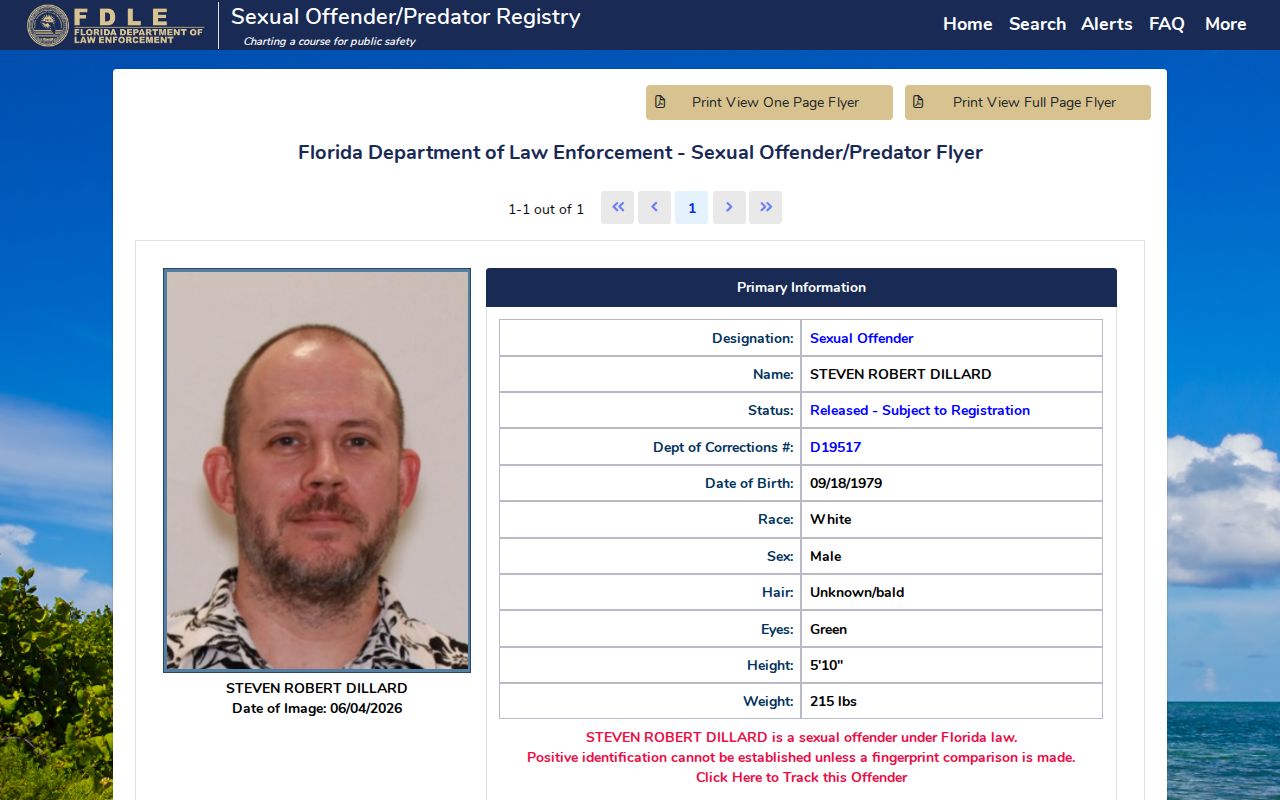
The profile layout connects the registry entry to its county of adjudication, where the clerk holds the underlying case record.
Note: The FDLE flyer is a registration profile, not a complete Florida criminal history or a substitute for fingerprint identification.
Florida Sheriff Registry Duties
The local registration office is the sheriff in the county where the registrant resides or is otherwise located. Sheriffs handle registration and reregistration, images, fingerprints and palm prints when required, change reports, and electronic updates to FDLE. The sheriff also controls local reporting days, places, and procedures.
Many core changes must be reported within 48 hours. These can include residence, phone, Internet identifiers, occupation and business contact details, vehicles, higher-education status, and travel information under the applicable statute. Transient registrants have an added 30-day in-person reporting duty. FDLE's Cyber Communication System allows certain people not supervised by FDC or DJJ to report specified changes online, but it does not replace every in-person sheriff duty.
Use the Florida county directory to reach the correct sheriff for registration locations, address questions, noncompliance reports, and local ordinances. Use the clerk in the conviction county for the criminal case.
Florida Registration Requirements and Levels
Florida duration and reporting frequency depend on the legal designation and qualifying offense, not a public three-tier score. Ordinary registration is generally for life. Limited relief exists, but it is narrow, fact-specific, and never automatic merely because time has passed.
| Florida Category | Ordinary Duration | Reporting Pattern / Relief |
|---|---|---|
| Sexual offender | Life | Usually twice yearly; a limited class may petition after at least 25 arrest-free years following release or sanction. |
| Specified sexual offender | Life | Four times yearly when the offense falls within section 943.0435(14)(b). |
| Sexual predator | Life | Four times yearly; current law generally requires a full pardon or the supporting conviction to be set aside. |
| Recognized out-of-state designation | Generally life while a legal basis remains | Removal requires proof that the source designation ended and no independent Florida basis remains. |
Sexual offenders generally report during the birth month and six months later. Predators and specified offenders report during the birth month and every third month after it. Sheriffs send updated information to FDLE within two business days. Failure to register or report required changes can be a felony.
Note: Florida registration frequency follows designation and qualifying offense, not a public Tier I, Tier II, or Tier III risk label.
Florida Sex Offender Alerts
The Florida Offender Alert System is free. A user can monitor an address and receive email when a registrant reports a move within the selected distance. A user can also track one registry record and receive notice of an address update anywhere in Florida. The service requires an email address and password, and the alert site warns that submitted email addresses are subject to Florida's broad public-records law.
For cross-state searches, the federal Dru Sjodin National Sex Offender Public Website links participating jurisdictions. NSOPW does not replace Florida's richer FDLE profile, the county sheriff's registration office, or the county clerk's source case. If an address seems stale, do not confront anyone. Contact local law enforcement or FDLE Offender Registry Services with the record details.
Florida Registry Counts Explained
FDLE reported that the database had grown to more than 17,000 registered predators and 72,000 registered offenders by October 2025. That total does not mean more than 89,000 people were living freely in Florida neighborhoods. Status and location must be read with the headline count.
OPPAGA's October 2024 analysis counted 86,207 living registry subjects: 69,961 offenders and 16,246 predators. It found 30,907 living in Florida communities, while 54,207 were confined or lived outside Florida and 1,093 were absconded. In other words, 63 percent were confined or did not live in the state. Among community residents, transient rates also varied widely by county.
Those figures show why a Florida sex offender search should use the State Status and Offender Status filters. A statewide total combines very different legal and custody situations. A profile marked confinement, out of state, absconded, or released subject to registration should not be described as if each status meant the same thing.
Lawful Use of Registry Data
The Florida registry supports lawful personal, family, and community-safety awareness. It does not authorize threats, harassment, vigilantism, confrontation, or altered republication. An address can change quickly, and FDLE relies on reporting agencies and registrants. A direct search is more current than an old saved flyer.
Section 775.21(10)(d) makes specified misuse a first-degree misdemeanor. Covered conduct includes using public registry information to extract payment from a registrant, knowingly publishing false information while presenting it as public-record information, or materially altering public information with intent to misrepresent it. FDLE also warns that using registry data to facilitate a crime is illegal.
Misuse is a crime. Florida registry data must not be used for harassment, retaliation, vigilantism, or a criminal act. Report suspected violations or urgent threats to law enforcement.
Community notification is also local. For a sexual predator, the sheriff or police chief selects an appropriate public-notice method and must notify specified schools and child-care facilities within the statutory radius and deadline. Florida's state residence rule applies to defined convictions and circumstances, while local ordinances can be broader. Confirm both the state statute and the current county rule.